Showing posts with label books. Show all posts

Tuesday, August 31, 2010

Book Review


The Blind Assassin by Margaret Atwood
I have always preferred Atwood's short fiction to her novels, but this is undoubtedly her masterpiece. Atwood tells the story of Iris Chase Griffen, who is coming to the end of her life and needs to set the record straight. Iris does this by telling the story of her early life, which is bound up in the story of her sister Laura who died at 25 and posthumously became a celebrated author. Iris's tale is interspersed with Laura's one novel, The Blind Assassin, which tells the story of a pair of secret lovers. When these lovers meet in squalid apartments, they tell each other the story of the planet Zycron and the fabled city of Sakiel-Norn, which exist in another dimension of space. As we move deeper into the tale, we understand that this is all one story, broken into facets. Atwood's writing is exquisite throughout, but never more so than when constructing the pulp scifi story the lovers tell. Laura is one of the most fascinating characters I've ever come across and Iris is so complete that you almost forget she isn't real. If you like Atwood, read this and enjoy. If you think you don't like Atwood, read this and become a fan.

Book Review


Dorothy Parker Stories by Dorothy Parker

This edition includes all the stories from two previous collections Laments for the Living and After Such Pleasures. These 24 short stories are little peaks into the minds, lives and conversations of various jazz age denizens including aging party girls, cheating husbands, young lovers, horse-faced nurses and society ladies. Dorothy Parker deserves every bit of her reputation as a legendary wit - my favourite story in the collection is A Young Woman in Green Lace, in which the title character finds it difficult to readjust to New York after spending three weeks in Paris. These are just perfect, beautiful, clever, heartbreaking gems of stories.

Friday, August 20, 2010

Book Review


The Age of Innocence by Edith Wharton
It's New York in the 1870s and Archer Newland has just become engaged to May Welland, his ideal woman, when her cousin the Countess Olenska arrives in New york fleeing from a bad marriage. Meeting the Countess forces Archer to re-evaluate everything he believes about the rigid social rules of the New York aristocracy and the life he had intended for himself. A gorgeously written love story about what we owe to ourselves and what we owe to others, about loving the goodness of a person more than wanting them, and about the prisons we build for ourselves. The story is only outshone by the atmosphere - Wharton paints old New York like a canvas. Five Stars.

The 1993 Martin Scorsese directed movie is well worth a watch, too. He recreates the atmosphere perfectly.

Book Review


Passionate Minds: Women Rewriting the World by Claudia Roth Pierpont

This was an impulse buy some years ago that has been gathering dust on a bookcase. I finally got around to reading it, and it was terrific. The book is a collection of short biographies/essays on the literary contributions of a diverse group of 20th century women writers, including Gertrude Stein, Hannah Arendt, Anais Nin, Zora Neale Hurston, Dorris Lessing, Ayn Rand and others. The essays were universally fascinating (Rand was slightly less of a kook than I had thought, Margaret Mitchell, Arendt and Lessing were every but as problematic in their personal lives as Hemingway, Eliot and Pound) and I have added at least a dozen books to my list of things to read right now. The writing is sharp, it moves at a clip and no more than 30 pages are devoted to any one author. Loved it. Five Stars.

Friday, August 13, 2010

Book Reviews


Amphigorey by Edward Gorey
This is a collection of fifteen of Gorey's odd and wonderful little illustrated stories. Gorey's work has to seen to be believed. From The Gashlycrumb Tinies which illustrates the alphabet with the horrible deaths of children, to The Unstrung Harp which tells the story of the the writing of a novel called The Unstrug Harp, Gorey is delightful and slightly mad in verse, prose and pictures. My favourite story in the collection is The Doubtful Guest about a strange creature that shows up at a family home one day, wreaks havoc and says for seventeen years. Five Stars!


Foundation by Isaac Asimov
It lives up to the hype. In a galaxy far, far away, the empire is crumbling and a dark age is approaching. Hari Selden has worked out the future for the next ten thousand years using the science of psychohistory and figured out how to keep the knowledge of the empire alive and cut down the dark ages to a mere millennium - by sending 100,000 people out to a planet at the edge of the empire and starting the Foundation. It's a fascinating story and it's truly astounding that this book was published in 1951. But! And it is a big but! In this far away future women are basically invisible and not involved in scholarship, trade, politics or religion, as far as I can tell. There are only two female characters in the entire book - both so minor they don't actually have names - whose combined presence in the story lasts about three pages. Three and a half stars for the story, negative five stars for severe gender issues.


The Wind-Up Bird Chronicle by Haruki Murakami
First, Toro Okada's cat goes missing. Then he meets several strange women and an elderly WWII soldier. Then his wife goes missing. Finally, he climbs down a well and things start getting weird. It's very long and there really isn't a lot of plot, but it kept me fascinated right up till the end (which I need to think about a bit more). Not all the threads are woven together, but they clearly aren't supposed to be. I didn't like it quite as much as Norwegian Wood, which was the first Murakami that I read, but it's still a solid three and a half.


Tuesday, May 4, 2010

Graphic Novel Roundup

So April was Graphic Novel month at Chez Laura.


Stitches: A Memoir by David Small
Yes, it is another graphic memoir about a dysfunctional childhood - but it's a really good one! The story is compelling - Small went into the hospital to have a growth removed and woke up without one vocal cord, rendering him mute and only found out later that he had cancer and wasn't expected to survive. And the art is very nice.


Robot Dreams by Sara Varon
This wordless and sweet tale of friendship between a dog and a robot is a perfect example of the Graphic Novel as a purely visual medium. Lovely.


The Golem's Mighty Swing by James Sturm
A 1920s Jewish baseball team, the Stars of David, run into trouble on tour and agree to a publicity stunt - creating a Golem. Sturm's first graphic novel about baseball and racism is fascinating and powerful, though I liked his later book Satchel Paige: Striking Out Jim Crow more.


Houdini: The Handcuff King by James Lutes and Nick Bertozzi
I love graphic novels that tell short, self contained stories, especially when the stories are true. This one is about a particular trick that Harry Houdini once did - jumping into the Charles River with his hands and feet bound in chains. Really cool.


Fables: Sons of Empire by Bill Willingham et al.
The fourth Fables graphic novel I have read this year is one of the better ones. Picking up where Fables: Wolves left off, the adversary plots the destruction of the Mundy world and Bigby and Snow White deal with family matters. The series is still well worth reading, but I wasn't too fond of the art in the second half.


The Wall: Growing Up Behind the Iron Curtain by Peter Sis
Brilliant non-fiction children's graphic book about growing up in Czechoslovakia during the cold war. Sis includes contextual political and cultural information and parallels it with the story of a boy who drew - a boy very much like himself. A brilliant story and a brilliant way to teach kids history. Loved it.


The Professor's Daughter by Joann Sfar and Emmanuel Guibert
Strange and wonderful graphic novel about the mummy of Imhotep IV falling in love with an Egyptologist's daughter in Victorian London. Gorgeous art.


The Eternal Smile: Three Stories by Gene Luen Yang and Derek Kirk Kim
Graphic novel month continues with these three short, fascinating and stylistically different stories exploring what these three people want in life, their various escapes from reality and the reconciliation of real life and ideal life. It doesn't quite live up to the genius of American Born Chinese, but I don't think anything could have.

Monday, April 12, 2010

Asterios Polyp by David Mazzucchelli


Asterios Polyp is the best graphic novel I have read since American Born Chinese. Asterios is a middle aged "paper architect" with a failed marriage. Then his apartment burns down and he buys a ticket for the first bus out of town. The story of Asterios' marriage is interwoven with his sojourn as a mechanic in the small town at the end of the bus ride. What makes this book so amazing is how Mazzucchelli uses the art to flesh out the story. Like the very best graphic novels, the art is not just illustrating the words, but adding dimensions to the story through its own language. Asterios Polyp is absolutely glorious. Read it!

Thursday, April 1, 2010

The Photographer by Emmanuel Guibert, Didier Lefevre and Frederic Lemercier


The Photographer documents a trip into Afghanistan made 20 years ago by a Medicin Sans Frontiers team to treat the sick and wounded during the Soviet invasion. Didier Lefevre went on the trip to photograph it, stayed with the mission in Afghanistan for a month and then left them and attempted to return to Pakistan with a caravan, which turned out to be a disaster that nearly killed him.

I love documentary graphic novels. but it seems like this is an area where a lot of the artists, authors and publishers don't really understand comics. What I mean by that is that in comics the words and the pictures should each add something to every panel - they should not contain exactly the same information. While The Photographer suffers from this to some extent (1/3 of all panels in the book are of Didier standing next to a horse on a mountain), the book is saved by two things. The comic panels remind us visually every minute of the terrain of Afghanistan and the journey, which is vital to the story. And the whole story is brought to life by Didier's photographs, which are amazing. It isn't a great comic, but it is a great story.

Wednesday, March 17, 2010

Wide Sargasso Sea by Jean Rhys


I read Jane Eyre when I was fourteen and didn't like it nearly as much as Wuthering Heights, which I had read right before. Jane was too timid and I didn't get what she saw in Rochester. The mad woman in the attic was the most interesting part of the book. Wide Sargasso Sea is the story of that mad woman in the attic - Antoinette Cosway, a white Creole from Jamaica. The story is told in three parts - first we see Antoinette's childhood in a Jamaica restructuring itself after the emancipation of the slaves, next we switch between Rochester and Antionette's povs during their honeymoon and finally, briefly, we see the mad woman in the attic.

It's a heartbreaking and beautifully atmospheric story - you can almost smell the flowers and feel the heat. Antoinette and Christophine are such vivid characters that Rochester, despite being one of the narrators, seems almost an afterthought. Which makes sense, as he seemed the same way in Jane Eyre. A fascinating read.

Monday, March 15, 2010

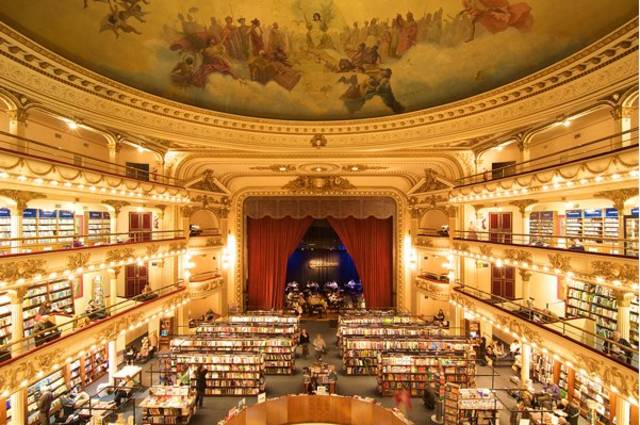
Beautiful buildings for books

Why doesn't Toronto have bookstores like this?


Librería El Ateneo Grand Splendid in Buenos Aires


image source: designtopnews.com

Bookstore Selexyz Dominicanen in Maastricht


image source: davereed

Livraria Lello in Porto

Saturday, March 13, 2010

Galapagos by Kurt Vonnegut


Kurt Vonnegut is my favourite writer ever. I'm rationing out the last few books of his that I haven't read yet, and this week I decided to treat myself to Galapagos. This is a story about evolution. More particularly, it is the story about how the progenitors of the modern human race came to be stranded on the island of Santa Rosilia one million years ago, in 1986 C.E. It is pure Vonnegut - cynical and funny and joyous. It doesn't quite reach the heights of Mother Night, The Sirens of Titan or Cat's Cradle, but it's still wonderful.

The Haunting of Hill House by Shirley Jackson


A professor with an interest in the paranormal rents a supposedly haunted house for the summer. He invites three strangers to come and stay with him in the house. The four of them arrive and begin to explore the house.

And so begins one of the scariest stories I've ever read. The writing just builds the ambiance and the pacing is perfect - the sense of dread just builds and builds. Having only read a few of Jackson's short stories before, I was so impressed with her craftsmanship in The Haunting of Hill House. If you like a good scare, read this book.

Anne of Avonlea by L. M. Montgomery


I've read Anne of Green Gables several times, and a number of Montgomery's other books including some of the later Anne books. When I picked up Anne of Avonlea to "reread" it, I realized that I'd never read it at all! Anne teaches at Avonlea School, starts a Village Improvement Society and grows up a little. It has all the joy and sweetness of Anne of Green Gables and reading it felt like visiting with old friends. I was disturbed by the random anti-French remarks, which I never noticed in Anne of Green Gables, and that dimmed my enjoyment slightly. But on the whole, a lovely book about the last days of youth and the realization that adulthood is looming over the horizon.

Franny and Zooey by J.D. Salinger


I read Nine Stories and The Catcher in the Rye when I was fourteen or so and I remember finding them wonderful and incredibly meaningful to me at the time. I re-read Catcher a few years ago and didn't feel that connection to Holden anymore - in fact I was annoyed by him. Salinger's death induced me to pick up Franny and Zooey, which has been sitting on my bookcase for more than a decade. I was completely surprised by how much I liked it. It's beautiful. Franny is in the midst of (perhaps a more severe version of) that breakdown that we all had in college, questioning herself and the universe itself. Zooey talks to her about life and meaning and ... anything else I say will spoil it. Salinger's writing doesn't always connect with the reader - I truly believe that you have to read Catcher at just the right age to get it - but when it does, it's just lovely. I'm so glad I read this now, when I was able to connect with Franny and Zooey, instead of when I was fourteen, when I would have thought I understood them but I really wouldn't have.

Midnight in the Garden of Good and Evil by John Berendt


I bought Midnight in the Garden of Good and Evil years ago in Savannah, an incredibly beautiful city where almost everyone tells you about this book when they find out you're a tourist. I put it on the shelf and forgot about it. In the fall I read Berendt's second book City of Falling Angels, and loved it beyond reason. That induced me to go back to this one and I'm very glad I did. Berendt's literary voice is perfection, the atmosphere is so thick you can breathe it in, the characters are really characters and the whole of it is the very best kind of literary non-fiction. Read it and be amazed. Suggested soundtrack: Ella Fitzgerald sing the Johnny Mercer Songbook.

The Ramayana: A Shortened Modern Prose Version of the Indian Epic by N. K. Narayan


The Ramayana: A Shortened Modern Prose Version of the Indian Epic by R. K. Narayan is a modern prose retelling of the life story of Rama, the seventh incarnation of the god Vishnu. In the story, Vishnu is born as a human, Prince Rama, in order to defeat Ravana and rid the world of the rakshasas (demons). The story tells of his birth, youth and early adventures, his meeting of and marriage to Sita (the incarnation of Vishnu's wife the goddess Lakshmi) and their exile to the forest for fourteen years as a result of a dynastic dispute. When Sita is kidnapped by Ravana, Rama and his brother Lakshmana search out his hiding place and wage a war that accomplishes Rama's purpose of destroying the rakshasas. Along the way they depose the monkey king Vali and put his brother on the throne, and meet the ever faithful Hanuman, who helps in their eventual victory.

The Ramayana is a bit like The Iliad in its scope and style. I enjoyed the plot and Narayan's writing style (I couldn't get through the older poetry version I first looked at). But the gender issues, oh the gender issues! Women are the instigators of all the bad things that happen in the story. Rama is exiled and his brother placed on the throne because his step-mother demands that as the unfulfilled promise that King has owed her for many years (she is manipulated to do this by her maid who was teased by Rama as a child for being a hunchback). Ravana kidnaps Sita because his sister Soorpanaka convinces him she is the most beautiful woman in the world and he must have her (she does this because she is in love with Rama and thinks she will have a chance with Sita out of the way). And when Sita is rescued at last, she must attempt to immolate herself to prove to Rama that she is still pure. All in all, a fascinating story if you can get past the misogyny.

Fifth Business by Robertson Davies


What is fifth business? The extra man in the story, neither hero nor villain. He is the man with no female counterpart, the one who moves the story along without it every really being his story. This is the life story of Dunstan Ramsey and his relationships with Mary Dempster, her son Paul, Boy Staunton and the mysterious Lisle. Starting in small town Ontario at the turn of the last century and spanning the world and seven decades, this is an amazing narrative experience. The characters are vivid, the prose is perfection and the story just evolved as I read. Fifth Business is a completely wonderful book. Five stars and a maple leaf.

The Marriage of Cadmus and Harmony by Roberto Calasso


The Marriage of Cadmus and Harmony is an odd, interesting read. Roberto Calasso attempts to create a unified theory of Greek mythology and its meaning. The work isn't completely cohesive - Calasso assumes his readers already know the myths and only tells little snatches of them. When I finished the book, the sections on Sparta (my least favourite) were at the front of my mind. After settling for a few days, the repeating theme of divine children and the tension between uniqueness and duplicity is what is staying with me most forcefully. It is at once a wholly original and fascinating read and I recommend it to those interested in the meaning of myth.

Wolf Hall by Hilary Mantel


I read Wolf Hall in January and it was shockingly good. A 650 page book on Tudor politics may not sound like a barn burner, but it was completely compelling and the writing! Oh, the writing is heavenly. The Booker committee has been on a roll the last few years with The White Tiger and this. Mantel builds a Tudor England with sights and sounds and smells and textures. Her version of Cromwell is a truly awe inspiring statesman, and her Thomas More is definitely not the one I remember from history class. Five thumbs up!

Two of the Best Graphic Novels I've Ever Read

This was a book talk I did for a youth collection development class.

Graphic Novels, due to their visual nature, are an excellent medium to tell stories about identity and belonging, about race and prejudice. Because comics literally put a face on the characters, they can create an instant understanding and connection between them and the reader. Today I want to talk about two books that are incredible examples of how this can be accomplished: American Born Chinese by Gene Luan Yang and Satchel Paige: Striking Out Jim Crow by James Sturm and Rich Tommaso.

American Born Chinese by Gene Yang was published in 2006 and was a Finalist for the National Book Award in young people’s literature that year, the first graphic novel ever to be recognized by the national book foundation. In 2007, it won the ALA’s Michael L. Printz Award and the Eisner Award for Best New Graphic Album.

Gene Yang is a high school computer science teacher who had previously published several short comics, including Gordon Yamamoto and the King of the Geeks. He is a major proponent of using comics in teaching, and has created a web resource on teaching with comics as part of his M. Ed. degree which can be accessed through his site, humble comics

American Born Chinese is Yang’s effort to say something about his experiences growing up as an Asian-American. It tells three stories; the legend of the Monkey King, who didn’t want to be a monkey, the story of Jin Wang, a Chinese American boy trying to fit into a predominantly white school in the suburbs, and the story of Danny, an all American high school kid whose life is ruined every year when his cousin Chin-Kee comes to visit.

These three stories appear at first to be separate, but by the end we discover that they are really three different parts of the same story. The Monkey King and Jin Wang both want to become something else, to stop being different and fit in with their peers. Danny does fit in, until Chin-Kee, the embodiment of every racist stereotype, comes to visit. Chin-Kee comes every year, because Danny, like the monkey king, cannot change what he is. He must accept and embrace all the parts of himself, and then Chin-Kee will no longer have power over him. The genius of this book is that Yang does not tell us this – he shows us and in such a way that the reader gets to figure it out for themselves. When the reader sees Chin-Kee, we understand what he is and what he means. That is the great power of the visual medium.

This is a serious theme, treated with a humorous, interesting story, told with exciting art, a perfectly constructed narrative and a beautiful voice. I recommend it very highly for ages 14 and over.

The second book I want to talk about is Satchel Paige: Striking Out Jim Crow by James Sturm and Rich Tommaso. It was published in 2008 and was the Eisner Award Winner for Best Reality-Based Work and an NAACP Award Nominee for Best Literary Work for Youth/Teens.

The author , James Sturm, is the co founder of the Centre for Cartoon Studies and the founder of the National Association of Comics Art Educators. His most famous book is the award winning The Golum’s Mighty Swing, which was also about baseball. The artist, Rich Tommaso, is the author and artist of a number of indy comics. The authors have created a great teacher’s guide for the this book, with lost of links to websites about Satchel Paige, the negro leagues and the Jim Crow laws.

Satchel Paige was the best pitcher in the negro leagues from the 1920s to the 1940s, and after the major league was integrated, he pitched in the majors until he was well into his 60s. He was the highest paid athlete in the world in the 1940s and one of the greatest baseball players who ever lived. But this is not a book about Satchel Paige. It is a book about the legend of Satchel Paige, and what he meant to two generations of black sharecroppers in the Jim Crow south. The book is written as a first person narrative, telling the story of a man who faced Paige during his brief career in the negro leagues, and fifteen years later, took his son to see an exhibition game between Paige’s all Stars and the local white-only team. In between these two events, we see how the white landowners maintained their control in the south through intimidation, humiliation, and violence and how this beat down the black sharecropper.

This is a story about representation and what it means for an oppressed person to see someone who looks like themselves stand up to the forces of oppression and how seeing that creates hope and belief in possibilities for the future.

Sturm and Tommaso deal with an incredibly difficult story in the most amazing way. The text and art are both simple and poignant throughout, and harsh when they need to be. This is an emotional book. It will make readers angry, and it will make them sad. Most of all, it left me in awe of the storytelling ability of Sturm and Tommaso. It is not an easy book, but it is a necessary book and I recommend it very highly for teens and adults both, and particularly for students of American History.

While both of these books are by male authors, about male characters, the quality of storytelling and importance of the subject matter make these must reads for boys and girls both. They are wonderful examples of what can be done in the comics medium and I would suggest these both for veteran comics readers and those who have never touched a graphic novel.